In the realm of global academia, European universities have long fostered collaborations with their Chinese counterparts. However, the heightened competition with China has brought knowledge security to the forefront of international discourse.
Key findings
Knowledge security concerns
Over the years, European universities have strengthened collaboration with their Chinese counterparts and other research institutes. While the COVID-19 pandemic brought most of these collaborations to a standstill, the loosening of COVID-related travel restrictions in February 2023 allowed Chinese universities to fully resume academic exchanges, offering their students and researchers the opportunity to study abroad.
Amidst these developments, an increasingly competitive landscape with China has given rise to concerns about knowledge security and the need for tighter controls on academic collaborations. Governments are increasingly advocating for stricter controls on economic assets, not just for the sake of national security but also to safeguard economic and technological advantages.
China's policies, such as its drive for technological innovation across various sectors under the "Made in China" initiative and the concept of Military-Civil Fusion (MCF), have amplified the debate around knowledge transfer through academic exchanges. Consequently, the possibility of knowledge transfer in academic research has become a critical subject of discussion, albeit one that has yet to be fully incorporated into export control debates.
The current landscape
The landscape of Sino-European academic collaborations is vast and multifaceted. To gain insights into the status quo, Datenna analysed 416 relevant collaborations across all fields of study, involving the top 20 Chinese universities and their European counterparts. While this is only a fraction of Chinese universities, these institutes have the highest quality of education and are best equipped to research relevant technologies.
The collaborations considered include substantial exchanges of knowledge, skills, educators, and students, emphasising the potential for significant knowledge transfer. Short-term exchanges or research activities that limit the scope of knowledge transfer were excluded from the analysis.
The data
From the data, the United Kingdom emerged as a significant player, with Sino-British academic collaborations constituting a substantial portion of these interactions. French institutions accounted for 20% of relevant research collaborations, followed by German institutions (9%) and Dutch institutions (7%).
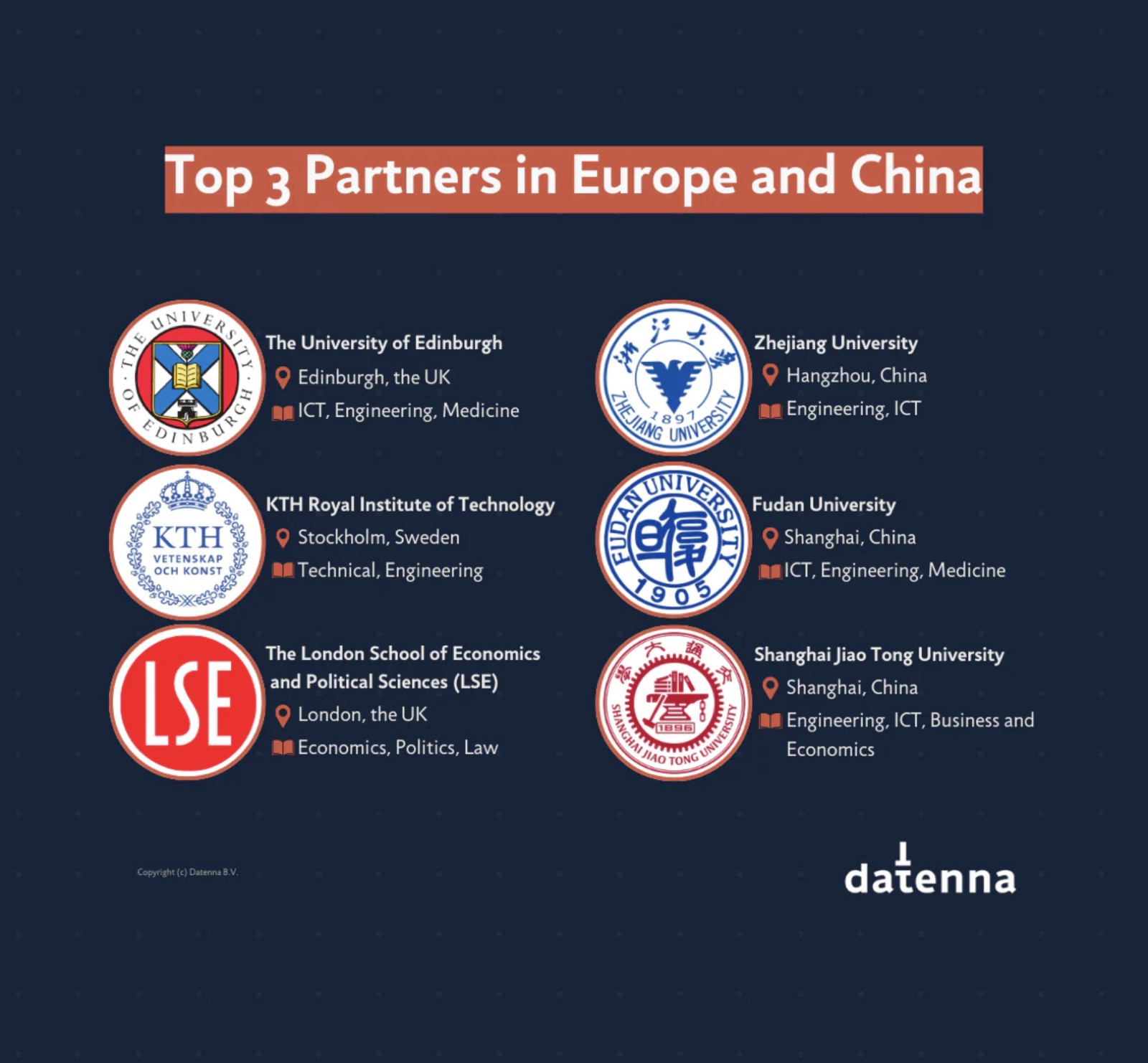
Among the diverse institutions involved, the top three European universities that actively collaborate with the selected 20 Chinese universities are the University of Edinburgh, KTH Royal Institute of Technology, and the London School of Economics and Political Science (LSE).
Likewise, on the Chinese side, Zhejiang University, Fudan University, and Shanghai Jiao Tong University have been at the forefront of such collaborative efforts. Northwestern Polytechnical University, one of the renowned "Seven Sons" universities in China, ranks fifth and has established 8% of all relevant collaborations. These "Seven Sons" universities are closely linked to China's defence industry — a connection underscored by a study from the Center for Security and Emerging Technology, revealing that three-quarters of Chinese defence State-Owned Enterprises (SOEs) employees have graduated from these institutions.
China's Seven Sons
The Seven Sons of National Defense is a group of Chinese national research universities known for their contributions to military research and close collaboration with the People's Liberation Army. These universities are instrumental in advancing China's military research and development and have a significant role in Chinese defence-related initiatives.
Every year, the majority of these universities are tapped for recruitment by Chinese defence conglomerates, and more than half of their budgets are allocated to defence-related research. This strong focus on defence is further highlighted by the supervisory role of the Ministry of Industry and Information Technology (MIIT), which oversees China's defence industry through its subsidiary, the State Administration for Science, Technology, and Industry for National Defense.
The Seven Sons of National Defense
Academic collaboration with the Seven Sons
Datenna's study included Sino-European academic collaborations with the likelihood of knowledge transfer of 13 top Chinese universities and added the Seven Sons. The left side of the figure below shows Sino-European academic collaborations of twenty top Chinese universities, including Seven Sons; the chart on the right shows Sino-European academic collaborations with Seven Sons exclusively.
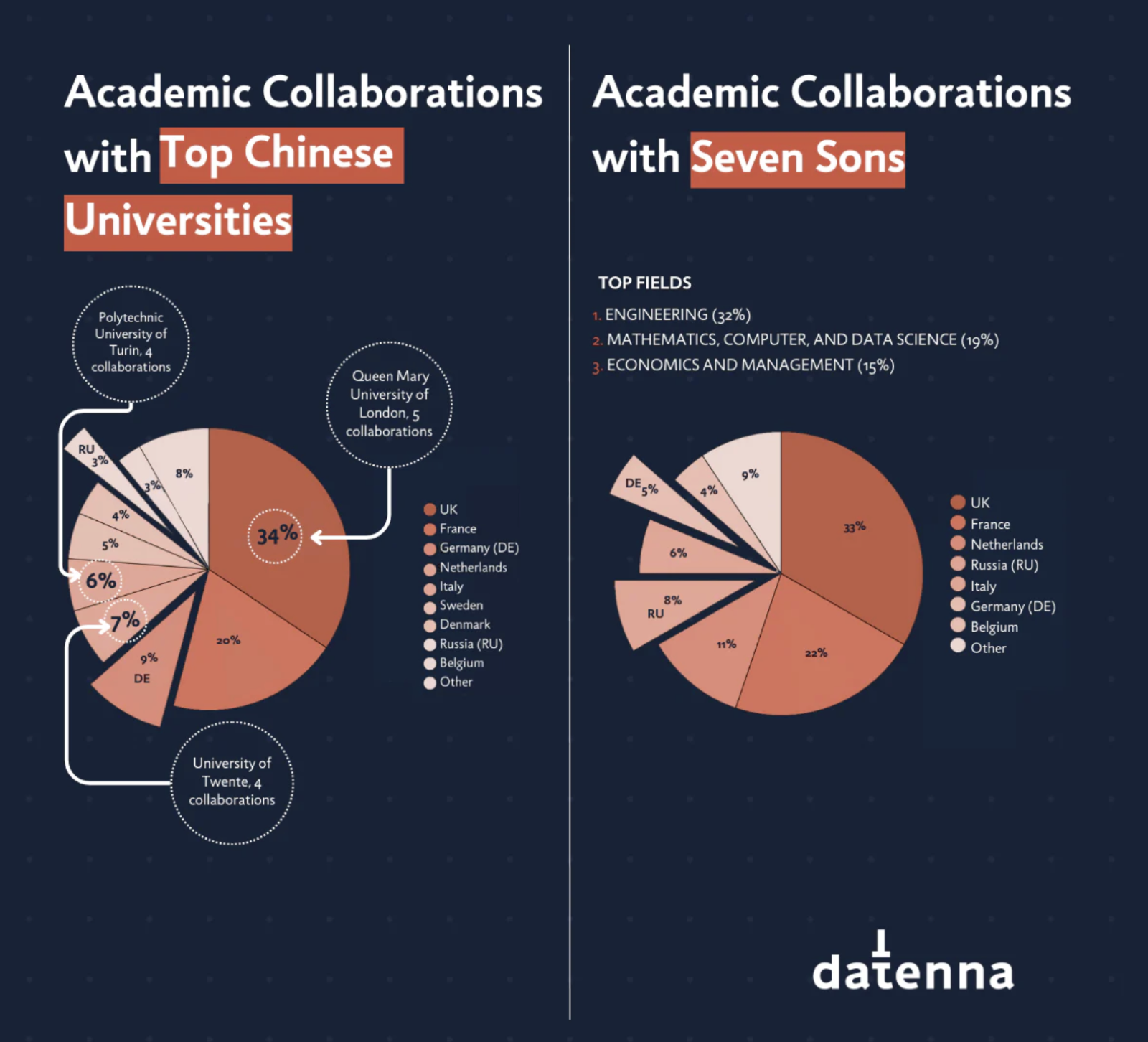
For most countries, collaboration with Seven Sons universities is in line with their share when considering a more comprehensive selection of universities. The UK, France, the Netherlands, and Italy are the countries with the most university collaborations with Seven Sons universities. The Queen Mary University of London established five academic collaborations with risky academic entities; the Polytechnic University of Turin and the University of Twente both established four.
When comparing the graphs, Germany and Russia stand out. Germany, which ranks third in academic collaborations with a broader range of Chinese universities (9%), drops to sixth place (5%) when considering only Seven Sons universities. Conversely, Russia exhibits the opposite trend, with a higher share of collaborations with Seven Sons universities than with regular universities. Collaborations with Seven Sons universities are primarily established in the fields of engineering (32%), mathematical, computer, and data science (19%), and economics and management (15%).
In an environment of heightened competition with China and its emphasis on technological advantages, academic collaborations are increasingly relevant in the context of export control. Access to data on Chinese academic partners, their affiliations, and preferred areas of research is fundamental, especially for collaborations that involve areas of strategic value to the Chinese government and the defence industry.
Academic collaborations must be critically assessed on a periodic basis to safeguard knowledge security. Collaborations with China's Seven Sons of National Defense should be approached with extra care, and assessments should be made on a case-by-case basis to prevent the unwanted transfer of knowledge on critical technologies.